
Fundamentals of Commercial Fishing
LESSONS
- How to Complete This Course
- Glossary
- What Is Maricert Maritime Certification
- Why Certificates Are Important
- What Professional Certificates Consist Of
- STSP Program
- SIPS Program
- Resources Used for Job Search
- What Are LinkedIn Badges
- How to Get LinkedIn Badges
- About Working in the Fishing Industry
- Commercial Species of Fish, Crabs, and Shrimp
- Areas of Application of Fishing Gear
- Beam Trawl
- Bottom Trawl
- Pair Bottom Trawling
- Pelagic Trawling
- Purse Seine Fishing
- Seiner
- Crab Fishing
- Longliner
- Name and Surname Check
- Final Test
- Your Certificate
Duration
3 hours for studying the theoretical material, 1 hour for completing the final test.
Certificate
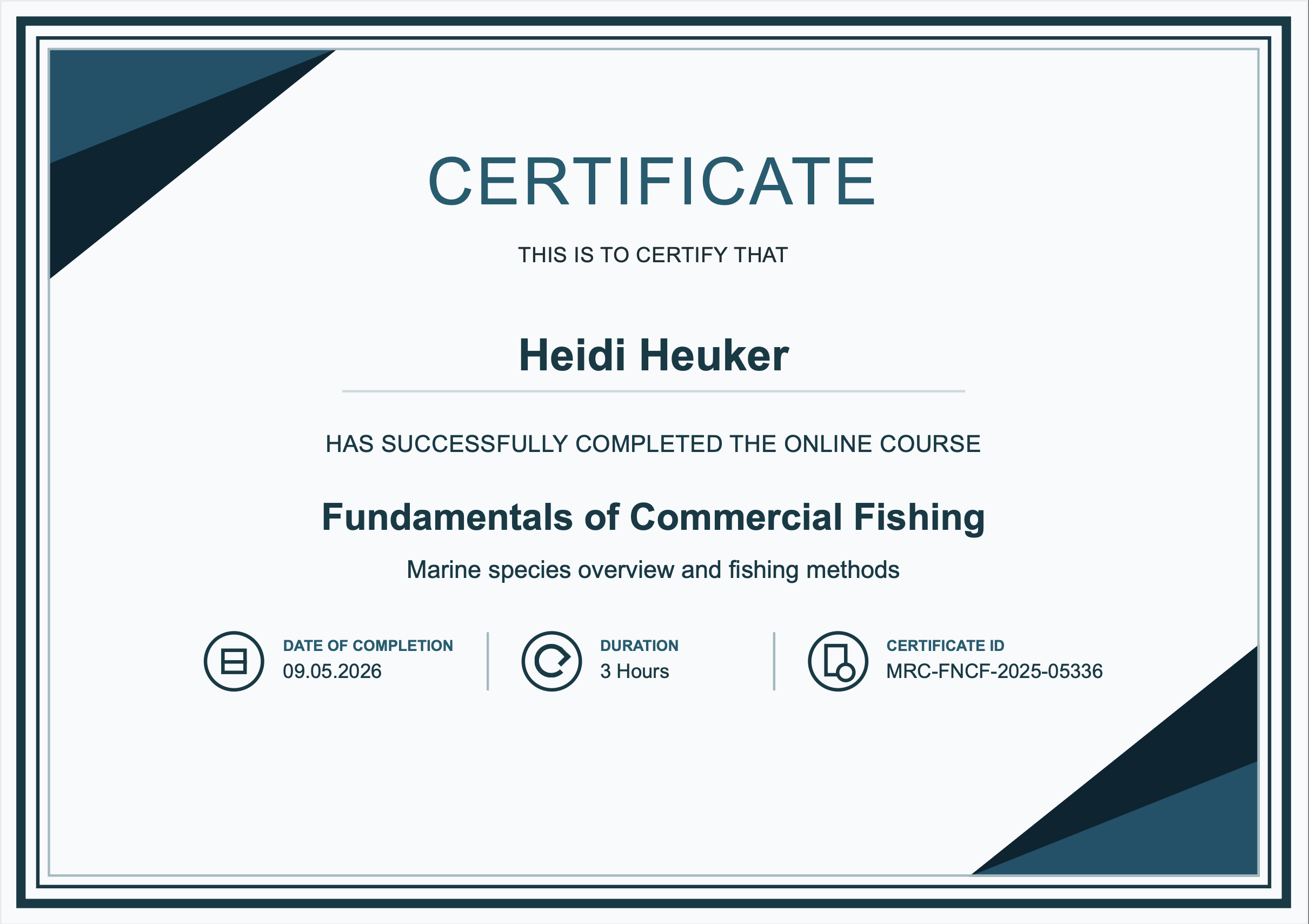
Upon successful completion of the online course, you will receive a certificate titled: "Fundamentals of Commercial Fishing".
Database registration
Each certificate has a unique serial number, is registered in our database for authenticity verification.
Course description
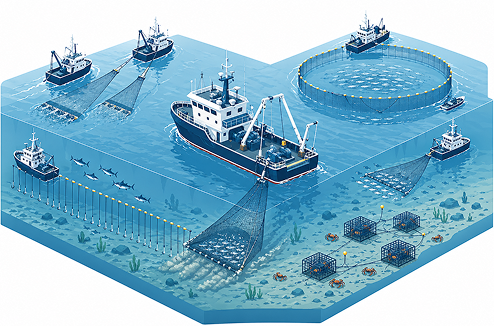
This course provides a structured and practical understanding of modern commercial fishing systems, focusing on how marine resources are harvested, managed, and processed within a unified industrial framework. You will explore the core fishing methods used in leading fisheries such as Norway, including bottom trawling, pelagic trawling, purse seining, longline fishing, and trap-based crab harvesting. The course explains how each method is directly connected to fish behavior, ocean depth zones, and environmental conditions. You will analyze the relationship between pelagic and demersal species, understand how sonar and hydroacoustic technologies are used to locate fish, and learn how fishing gear is designed to operate efficiently within specific layers of the water column. Special attention is given to the logic behind fishing operations — not just how equipment works, but why it is used in certain conditions and how decisions are made in real working environments. The course bridges traditional fishing knowledge with modern industrial practices, highlighting sustainability, selectivity, and efficiency. Through detailed explanations and real-world examples, you will gain insight into how large-scale fishing operations are organized — from resource detection to capture and onboard processing. By the end of the course, you will understand the full structure of the fishing industry and how different roles, vessels, and technologies are interconnected within one system.
What you’ll learn
- understanding pelagic and demersal zones and how they define fishing methods
- how trawling, seining, longline, and trap systems operate in real conditions
- the role of sonar, echo sounders, and hydroacoustics in fish detection
- how fish behavior influences gear selection and fishing strategy
- the structure of modern fishing operations from capture to processing
Who this course is for
- This course is designed for beginners, aspiring seafarers, and anyone interested in working in the fishing or seafood industry. It is also suitable for maritime workers, students, and professionals who want to understand how commercial fishing systems operate in practice. Additionally, it is valuable for those planning to enter international fisheries, including fishing vessels, crab fleets, and seafood processing sectors, and who want a clear, structured understanding of the industry before starting.
FAQ
First, please check your spam or promotions folder — sometimes emails land there. If you still don’t see anything, contact us at https://maricert.com/contact/ — we’ll check your order and grant access as soon as possible.
You can retake the test as many times as needed. There are no penalties or additional fees.
Yes. All lessons and tests are in written format. You can use Google Chrome with auto-translation or third-party tools. Our goal is to make learning accessible to everyone.
Absolutely. The platform is fully optimised for mobile. You can study from your phone, tablet, or laptop — whichever is most convenient for you.
You get 12 months of access from the date of purchase. You can study at your own pace. If the course isn’t completed within that period, access will be revoked without a refund. Refunds are not available once access is granted, as digital content is considered delivered in full (as per the UK Consumer Contracts Regulations 2013).
Your certificate will be sent to your email and also registered in the Maricert verification database. You'll receive a PDF version that you can attach to your CV.
Each certificate includes a unique ID and QR code. Employers can verify authenticity via the Maricert database or directly through the Maricert website.
Yes. We recommend including a direct maricert.com link in your CV, cover letter, or LinkedIn profile to help build trust with employers.
No. Our courses are open to everyone, including beginners. You don’t need any maritime documents to enrol.
They can be added to your CV when applying for jobs on crabbing vessels, fishing fleets, seafood factories, and maritime logistics companies. They’re especially valuable for those with no prior experience.
Yes. While our certificates don’t guarantee a visa, they can serve as additional proof of qualifications when applying for seasonal or work visas.
We are not a recruitment agency, but our certificates and diplomas can improve your chances when applying directly to employers — especially if you’re new to the industry.
Yes. Maricert is officially registered in the UK Register of Learning Providers (UKPRN: 10098283) and complies with ICO (Information Commissioner's Office) data protection regulations.
Yes. You can purchase a course using another person’s email address or contact support to have access transferred after the purchase.